Foldable Robotics at Escuela Verde
This week I have been fortunate to be able to visit Escuela Verde (the Green School) in Vieques, PR. They are beginning their 6-week quest on the topic of Physics, and I get to visit two days this week to talk about robotics and help them use their arts and craft skills towards learning physics basics. On Tuesday I stopped by for my first day. The format is challenging, because we have a wide range of learners, from 4 all the way to 15. Here's what we talked about on Tuesday:
Session 1 (35-40 minutes):
I sat with the kids and walked them through some videos I have collected, of my work and the work of others. We talked about:
- My Robots: Some examples, why do I make soft, easy to make robots? How I use physics and simulation to make my robots better. Common questions:
- Did I actually make them?
- Who made the robots?
- Am I a scientist? What's engineering? Whats the difference?
- Are these robots kind of like Lego robots?
- Is it fun to make robots?
- Do you know all the people in my photos and videos?
- Bio-Inspired Robots: robots inspired by birds, cockroaches, fish, geckos, etc. Kids are so lucky these days, they have so many sources of inspiration in the biological AND engineered world!
- What is bioinspiration?
- Product Packaging: People make some extraordinary boxes for packaging, display, shipping, and material savings.
- Deployable Structures: Linkages and morphing/transformation feature prominently in architectural innovations too -- we talked buildings, architecture, and dynamic sculptures like "Strandbeest".
- Tensegrity Systems: Another, very similar paradigm with different rules, but techniques we can draw from.
- Origami: Typically we think of origami as folding to make a shape, but I showed a lot of origami-inspired devices that move or "deploy",
- Pop-up Books: Pop-up books blend the right amount of art and engineering together to get the point across -- you can use paper to make engineered motion!
Session 2: 45-60 minutes
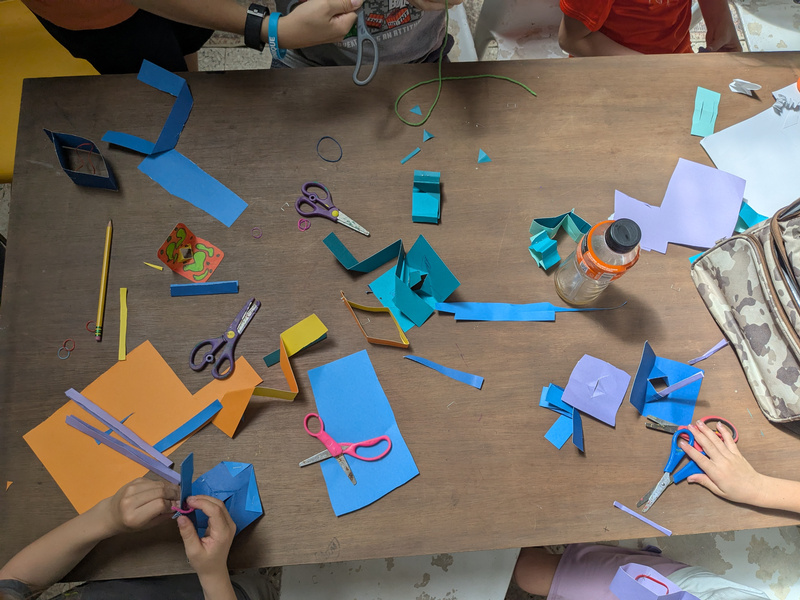

Materials:
- Cardstock
- Scissors
- Staplers
- String
- Markers / Pencils
- Straws
We walked through some basic elements of mechanisms, making them along the way:
- What are the basic parts of a mechanism? (links and joints)
- What are serial mechanisms? How do you make them?
- What are parallel mechanisms? How to make a four-bar mechanism.
- What are planar mechanisms
- How many ways can joints move? What about in the human body:
- Elbow
- Wrist
- Ankle
- Knee
- Hip -- ball and socket / spherical joint
- What are Degrees of Freedom
- How many degrees of freedom are there with objects in the world? (6) How do you count them?
- Can you make a hip joint just with folding? (Yes!)
- How do you store energy?
- gravity
- springs / rubber-bands
- How do you use rubber bands to store energy in a mechanism
- What are tendons? Where are the muscles for your hand actually located? How is that muscle force transmitted out to your fingers?
- How do you use string like a tendon in a mechanism? Can you route string with other materials like through a straw? Why would you want to?
- What's the difference between strong and stiff?
- What's an I-beam? how is a corrugated roof better than a flat roof?
- How do you make links stronger? (geometry) What are some easy shapes?
- How to make your first popup-book
- How to add legs
Sessions 3 and 4 on Thursday, so I'll let you know what we did after that! Thank-you to Jennifer Smith for the invitation.